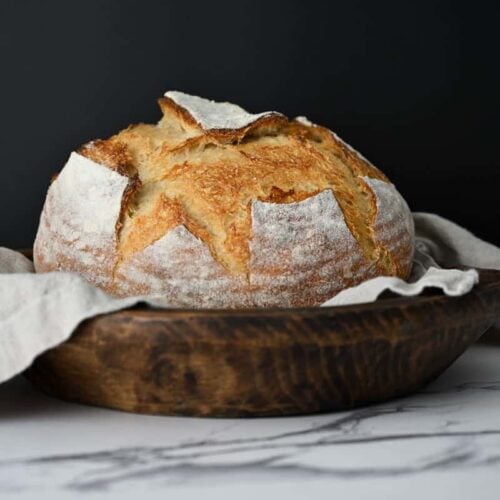
Same Day Sourdough Bread Recipe
Enjoy fresh, homemade sourdough in just one day! This easy same-day sourdough bread recipe takes you through mixing, fermenting, shaping, and baking in a fraction of the usual time.
Want to Save This Recipe?
Enter your email & I'll send it to your inbox. Plus, get great new recipes from me every week!
By submitting this form, you consent to receive emails from Lockrem Homestead
Ingredients
- 250 g sourdough starter 1 cup
- 250 g water 1 cup
- 10 g salt 2 tsp
- 313 g bread flour 2½ cups
- 62 g whole wheat flour ½ cup
Instructions
Feed the Starter
- Ideally, you want the starter to be ready first thing in the morning. I like to feed my starter the night before as follows for this recipe: a 1:4:4 ratio, 40g starter: 160g flour: 160g water. This sourdough starter ratio gives me plenty of active sourdough starter, so it's ready at its peak in the morning.
- However, you can feed the starter and make the bread all in one day. To shorten when the starter comes to peak, I suggest a feeding ratio of 1:1:1, 120 g of starter, flour, and water.
- Cover and let it rest at 77°F/25°C – 80°F/26°C until its bubbly and doubled in size.
- Skip this step if your starter is already activated and ready to bake with.
Mix the Dough
- Add active starter, warm water, salt, whole wheat flour, and bread flour in a large mixing bowl. Mix with a dough whisk until all of the flour is incorporated. Cover with a plate or a piece of plastic wrap so the dough doesn't dry out, and allow it to rest in a warm spot for 30 minutes.250 g sourdough starter, 250 g water, 10 g salt, 313 g bread flour, and 62 g whole wheat flour
Stretch and Folds
- Perform 3-4 sets of stretch-and-folds with 30-minute intervals.
- Pull the edge of the dough straight up before folding it over itself to the middle of the bowl. Rotate the bowl 90 degrees, and repeat, working your way around the sides of the bowl. Stretch and fold the dough 10-15 times, or until you feel it start to become tight and resistant. During the first stretch and folds, the dough is shaggy and breaks easily. Remember to keep the dough warm during the stretch and folds.
- Cover the bowl and allow it to rest before the next set of stretch and folds. You'll notice the dough becomes soft and elastic by the last set of stretches.
- Perform the windowpane test to see if the gluten is developed. Stretch the dough thinly, and if it holds without breaking, it's ready to bulk ferment. If the dough breaks, it needs another set of stretch and folds. Once the dough passes the windowpane test, its ready to bulk ferment.
Bulk Ferment
- Cover the bowl and allow to rest in a warm place. If your kitchen is cool, find a warm place like an oven with the light on or a proofing box. The dough is ready when there are bubbles below the surface, a domed top, and it has risen by 40-50%
- If it does not show these signs, continue to let the dough rise to finish bulk fermentation. At a dough temperature of 75°F, my dough is ready in 3-4 hours from the time it is mixed.
Shape and Proof
- Use a bowl scraper and turn out the dough onto a clean work surface dusted with a bit of flour.
- Shape the dough. I like to use the caddy clasp method. Its simple and easy for beginners.
- Position your hands under sides of the dough and fold together. Pinch the seams close. Reposition your hands so they're under the top and bottom of the dough and fold together.
- Using a bench scraper, lift the dough, seam side up, into a proofing basket dusted with a bit of rice flour. Stitch the seams close if needed.
- Cover the dough and let it rest for its second rise.
- Preheat the Dutch oven at 450°F/230°C.
- The dough is done proofing when it's light and puffy-looking. I like to do the poke test. Gently poke your finger into the dough. If it springs back fully, it needs more time. If it fills in partway, it's ready to bake.
Bake
- Place a piece of parchment paper over the top of the banneton and flip, so the dough is resting on the parchment paper.
- Score the top of the dough with a lame, clean razor blade, or sharp knife, and carefully place it in the hot Dutch oven. Replace the lid, place in the hot oven, and bake for 30 minutes.
- Remove the lid and bake for an additional 10 minutes or until the top of the bread is golden brown. The bread is done when the internal temperature reaches 200°F/94°C with a digital thermometer. If you don't have a thermometer, use the thump test. Invert the bread and tap the bottom of the loaf. If the bread sounds hollow, then its baked through. If it sounds dull and heavy, there's still moisture in the dough and its not done baking.
- Remove the bread from the Dutch oven and place the bread on a cooling rack.
- Wait for the bread to cool to room temperature before slicing.
Storing Same Day Sourdough Bread
- Room Temperature - Place the bread in an airtight container and store at room temperature for up to 4 days. Over time, the bread will become soft and dry out. To revive, preheat the oven to 450°F/C. Run the loaf under water for 2 seconds and then place in the oven for 10 minutes until the crust is crispy. Freeze - Place a whole loaf into a freezer safe bag and remove as much air as possible, or wrap tightly in plastic wrap. Alternatively, preslice the loaf before freezing. To thaw, let the bread warm up on the counter for a few hours. Presliced pieces can be toasted individually right from the freezer.
Notes
Nutrition information is automatically calculated, so it should only be used as an approximation.
Helpful Tips for Sourdough Same Day Bread
- Mature Starter - For the best results, be sure your starter is healthy and well established.
- Kitchen Scale - I recommend using a kitchen scale and weighing your ingredients rather than using volume. The amount of flour can vary so much depending how you add it to the measuring cup. A kitchen scale gives you consistent amounts so you can have dependable results.
- Cool the Dough - Pop the banneton into the freezer while the oven preheats so the bread doesn't overproof. If you have the time, refrigerate the dough for a few hours for a short cold ferment. Cold dough is easier to score and can help with oven spring.
Nutrition
Calories: 98kcalCarbohydrates: 20gProtein: 3.3gFat: 0.5gSaturated Fat: 0.1gPolyunsaturated Fat: 0.2gMonounsaturated Fat: 0.04gSodium: 243.7mgPotassium: 33.7mgFiber: 1gSugar: 0.1gVitamin A: 0.7IUCalcium: 4.9mgIron: 0.3mg
Tried this recipe?Let us know how it was!
