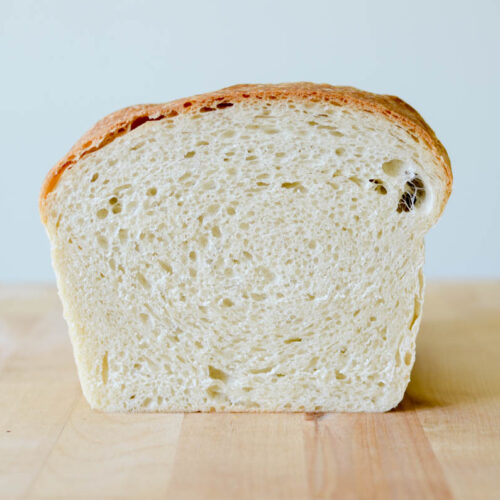
Sourdough Sandwich Bread
This sourdough sandwich bread is soft and tender with a buttery flavor. Made from soft, airy sandwich dough made with 100% sourdough starter, it's sure to be a household favorite!
Want to Save This Recipe?
Enter your email & I'll send it to your inbox. Plus, get great new recipes from me every week!
By submitting this form, you consent to receive emails from Lockrem Homestead
Equipment
- 9x5 bread loaf pan
- stand mixer with a dough hook attachment
- kitchen scale
Ingredients
Levain
- 42 grams ripe/mature starter
- 42 grams warm water
- 42 grams bread flour
Sourdough Sandwich Bread Dough
- Use all of the levain or substitute 125 g (½ cup) active sourdough starter
- 250 g water 1 cup
- 25 g honey 1 tbsp
- 11 g salt 2 tsps
- 500 g bread flour 4 cups
- 85 g unsalted butter 6 tbsp
Instructions
Levain
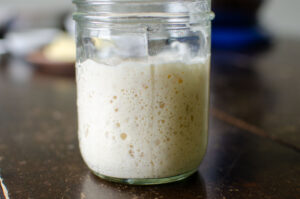
- This recipe calls for a levain mixed the night before you mix the dough. Combine 45 g sourdough starter, 45 g warm water, and 45 g bread flour in a small bowl. Cover and let it sit at room temperature for 8 hours. The levain is ready when it has doubled in size, has lots of bubbles, and a slightly sour aroma.
Mix the Dough
- Once your levain has doubled in size, combine all of the ripe levain with 25 g (2 tbsp) honey, 250 g (1 cup) water, 500 g (4 cups) bread flour, and 11 g ( 2 tsp) salt in the bowl of a stand mixer.
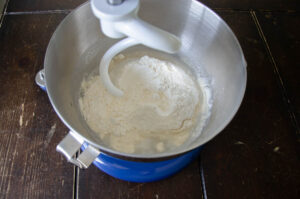
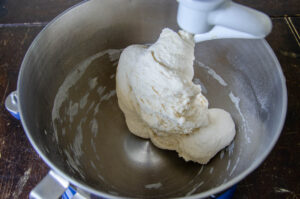
- Mix on low speed with a dough hook attachment for 4-5 minutes. The dough will come together and pull away from the sides of the bowl to form a cohesive ball.
Autolyse
- Cover the bowl and let the dough rest for 30 minutes. I leave the bowl in the stand and drape a tea towel over the mixing bowl and around the dough hook attachment.
- Prepare 85 g (6 tbsp) butter by cutting it into ¼-inch-thick pats and place them on a dish to warm to room temperature.
Incorporate the Butter
- Check that the butter is at room temperature. Press on a pat of butter with your finger, it should be easy to indent without being mushy or melted.
- Remove the towel from the bowl. With the mixer on low speed, add a pat of butter to the dough, one at a time, until it's completely incorporated into the bread dough. Continue with the remaining pats of butter. This process should take 6-8 minutes.
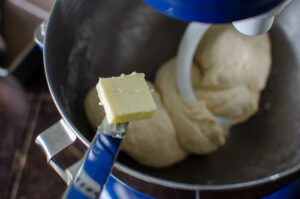
- Initially, the dough will look slightly shaggy. After you add the butter, the dough will be smooth, silky, and have a light shine.
Strengthen the Dough and Bulk Ferment | First Rise
- Cover the bowl and place it in a warm place to let the dough rise. For the first 90 minutes of the bulk fermentation, do a series of stretch and folds every 30 minutes for a total of 3 sets.
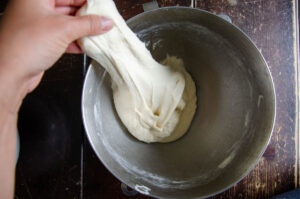
- With wet hands, grab one side of the dough and lift it straight up and over to the other side. Rotate the bowl a quarter of a turn and stretch and fold that side. Continue working your way around the bowl until the dough feels resistant. By the last set of stretch and folds, the dough will be smooth, stretchy, and won't stick to your hands.
- After the last set of stretch and folds, cover the bowl and let the dough rest for the remainder of the bulk ferment. The dough took about 5 hours at 72°F/22°C.
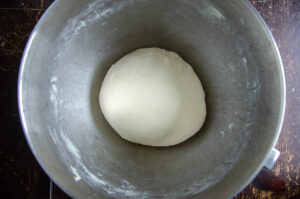
- The dough is done bulk fermenting when it has risen significantly with small bubbles beneath the surface. Also, where the dough meets the edge of the bowl will be domed downward.
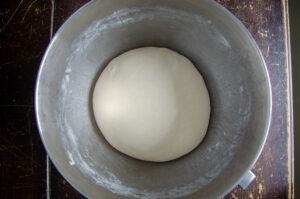
- Optional Cold Ferment: After the bulk fermentation is done, cover the bowl and refrigerate overnight. The next morning, continue with shaping the dough, letting it proof, and bake as directed.
Shape
- Grease a 9x5 bread pan with butter or line it with a piece of parchment paper.
- Using a bowl scraper or silicone spatula, gently scrape the dough onto a clean work surface. Roll out the dough into a rectangle 8"x 10" to help flatten out some of the air bubbles. The dough should be easy to handle and not stick to the counter. If you find that the dough is sticking, gently lift the dough and dust the counter underneath with a bit of flour.
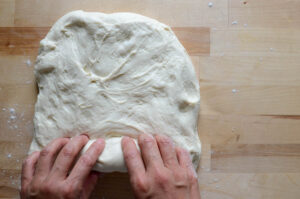
- Starting at the short side of the dough, roll the dough into a long cylinder.
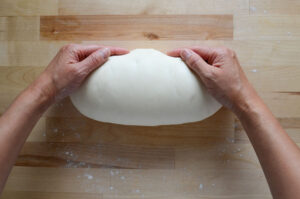
- Tuck the ends of the bread dough under. With both hands cupping the far end of the dough, pull the bread dough towards yourself, creating a bit of surface tension on the top of the bread dough. Lift the dough with both hands into the oiled loaf pan.
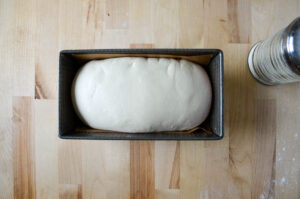
Proof | Second Rise
- Place the pan into a large plastic bag, seal it, and set it in a warm place for its second rise. Let the dough proof until the dough is 1" - 2" above the rim of the pan.

Bake
- When the bread is done proofing, preheat the oven to 375°F/190°C with the oven rack set in the middle position.
- Place the bread pan into the preheated oven and bake for 45 minutes or until the sourdough sandwich bread internal temperature reaches 200°F/95°C with a digital thermometer and the top is a light golden brown color.
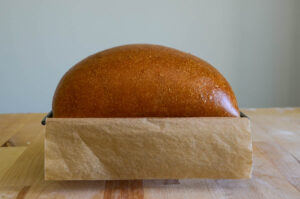
Store
- Allow the bread to cool completely before placing it into an airtight container. Store at room temperature up to 4 days.
Notes
The exact amount of time this takes largely depends on the temperature of your kitchen. If the air temperature is warmer, the dough will ferment faster. However, if the air temperature is cooler, the dough takes longer to finish bulk fermenting.
Do you have to use a levain in this recipe?
No. If you have a well-maintained and frequently refreshed starter, you can substitute 125 g (½ cup) active sourdough starter for the levain in the recipe.Why is my sourdough sandwich bread dense?
To achieve a soft sandwich bread, the dough needs to be properly proofed. If your sourdough sandwich bread loaf is dense, it's likely under-proofed and needs more time to proof in the bread pan. Do not bake the dough until it has risen above the edge of the pan. It may take longer than you think - Be patient! If it's not rising, place the bread in an oven with the light on. I've had some loaves take up to 8 hours to properly proof.Do I need to use a stand mixer?
Nope, you can make this bread with a large bowl and knead it by hand. Add a pat of butter to the dough and spread it thinly over the dough with the heel of your hand before continuing to knead it in.What size loaf pan should I use?
If you want an extra tall loaf, use a 8x4 bread loaf pan instead of a traditional 9x5 loaf pan. For perfectly straight sides, use a 9 x 4 Pullman loaf pan without the lid. Nutrition information is automatically calculated, so it should only be used as an approximation.Nutrition
Calories: 220.2kcalCarbohydrates: 34.5gProtein: 5.5gFat: 6.5gSaturated Fat: 3.7gPolyunsaturated Fat: 0.5gMonounsaturated Fat: 1.6gTrans Fat: 0.2gCholesterol: 15.2mgSodium: 358.1mgPotassium: 48mgFiber: 1.1gSugar: 1.9gVitamin A: 177.9IUVitamin C: 0.01mgCalcium: 9.4mgIron: 0.4mg
Tried this recipe?Let us know how it was!
