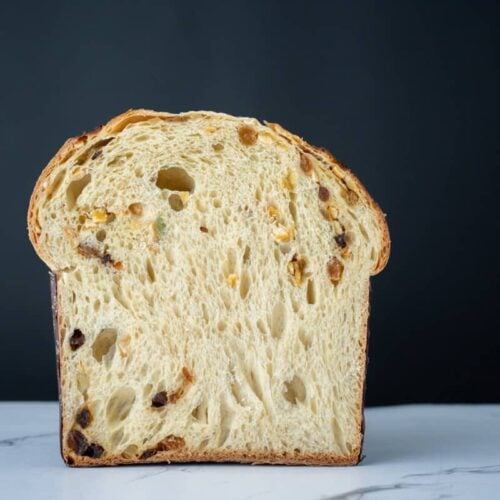
Sourdough Panettone
A classic Italian dessert, this easy sourdough panettone recipe is a delicious enriched bread filled with egg yolks and butter for a soft and tender crumb that melts in your mouth. This festive dessert bread has a sweet orange flavor with plenty of candied fruit studded throughout.
Want to Save This Recipe?
Enter your email & I'll send it to your inbox. Plus, get great new recipes from me every week!
By submitting this form, you consent to receive emails from Lockrem Homestead
Equipment
- kitchen scale
Ingredients
Dried Fruit Filling
- 120 g candied orange peel ⅔ cup
- 60 g candied citron ⅓ cup
- 80 g golden raisins ½ cup
- 40 g raisins ¼ cup
- 45 g light rum ¼ cup
- 150 g hot water ¾ cup
Panettone Bread Dough
- 125 g sourdough starter ½ cup
- 133 g sugar ⅔ cup
- 3 large eggs
- 3 large egg yolks
- 188 g water ¾ cup
- 2 tsp vanilla extract
- ½ tsp orange extract
- 1 large orange zest
- 1 tsp salt
- 625 g bread flour 5 cups
- 170 g unsalted butter 12 T, 1½ sticks
Instructions
Mix the Dough
- Feed your sourdough starter and allow it to come to its peak.
- Add active sourdough starter, sugar, eggs, egg yolks, water, vanilla extract, orange extract, orange zest, and salt to the bowl of a stand mixer fitted with a dough hook.125 g sourdough starter, 133 g sugar, 3 large eggs, 3 large egg yolks, 188 g water, 2 tsp vanilla extract, ½ tsp orange extract, 1 large orange zest, and 1 tsp salt
- Mix on low speed for 30 seconds to break up the eggs and starter into the rest of the ingredients.
- Next, add the bread flour and mix on medium-low speed for 15 minutes. In the first few minutes of mixing, the dough is shaggy and breaks easily when stretched. It has little gluten development and needs more mixing. The dough is ready when it passes the windowpane test.625 g bread flour
- With the mixer on low, add the butter one tablespoon at a time. Mix until it disappears into the dough before adding more butter. Once you add all the butter, mix for 30 more seconds, or until the butter is fully incorporated. The dough becomes silky and holds its shape when stretched.170 g unsalted butter
Prep the Dried Fruit
- While the dough is mixing, prepare the dried fruit. Add the dried fruit to a small bowl and add the rum and hot water to it. Cover and let soak overnight.120 g candied orange peel, 60 g candied citron, 80 g golden raisins, 40 g raisins, 45 g light rum, and 150 g hot water
Bulk Ferment
- Transfer the panettone dough to a clean container and cover. Let it rise overnight at room temperature. My kitchen was 72°C/22°F and it took about 14 hours to ferment.
Add the Dried Fruit
- The next morning, the dough will have almost doubled in size.
- Drain the dried fruit.
- Turn the dough out onto a floured work surface. Roll out the dough to a 12x18-inch rectangle in landscape orientation.
- Add ¾ of the dried fruit to the left ⅔ of the dough, leaving the remaining ⅓ without fruit. Gently press the dried fruit into the dough.
- Starting with the section of dough without fruit, perform an envelope fold to create layers of dried fruit. Fold the fruit-free ⅓ of the dough over the middle ⅓. Then, fold the fruit-filled ⅓ over the middle.
- Scatter the remaining dried fruit over the bottom half of the dough, then fold the dough in half. Gently flatten the dough to 1½ inches thick.
- Fold each corner toward the center and pinch them together to form a ball. Using a bench scraper, carefully flip the dough over and gently shape it into a neat round.
Proof
- Grease the mold before lifting the dough into the panettone mold with the seam side down.
- Let the dough rise until it's risen above the lip of the mold.
Bake
- Preheat the oven to 375°F/190°C.
- Score a cross on the top of the dough and place a pat of butter on top.
- Place the mold onto a baking sheet or shallow baking dish and bake for 10 minutes. Reduce the oven temperature to 325°F/163°C and continue baking for 60-75 minutes. The bread is done when the internal temperature reaches 195°F/90°C.
Cool
- Remove the bread from the oven. Skewer the bread 1 inch above the bottom, and hang upside down to cool.
Notes
- The dough is soft and tends to stick easily. Make sure your work surface is dusted with flour when rolling out the dough to make folding and shaping easier.
- Don't rush the bread dough. Enriched bread doughs take longer to ferment and proof than traditional sourdough breads. Sourdough take longer to ferment and proof in cooler temperature.
- Because the enriched dough doesn't have a lot of structure, quick and decisive actions are best when shaping. A bench scraper helps lift the dough.
- Once the bread dough is proofing in the mold, I like to place it in a large plastic container with a lid to keep the dough from drying out. You can also use a stock pot or an inverted deep bowl.
Nutrition
Calories: 348.8kcalCarbohydrates: 53.8gProtein: 6.9gFat: 11.1gSaturated Fat: 6.2gPolyunsaturated Fat: 0.9gMonounsaturated Fat: 3gTrans Fat: 0.4gCholesterol: 92.1mgSodium: 175.3mgPotassium: 124.8mgFiber: 1.6gSugar: 20.6gVitamin A: 368.2IUVitamin C: 1.3mgCalcium: 24.9mgIron: 0.8mg
Tried this recipe?Let us know how it was!
