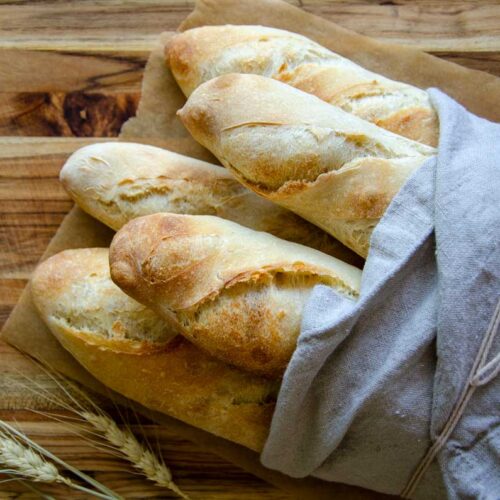
Sourdough Baguette
Enjoy a beautifully shaped sourdough baguette with its soft, airy center and thin, crisp crust. Learn how simple it is to make this artisan loaf in this step-by-step recipe, ideal for any home baker!
Want to Save This Recipe?
Enter your email & I'll send it to your inbox. Plus, get great new recipes from me every week!
By submitting this form, you consent to receive emails from Lockrem Homestead
Ingredients
Levain
- 28 g water
- 28 g ap flour
- 28 g active sourdough starter
Sourdough Baguette Dough
- 84 g All of the levain ⅓ cup
- 334 g water 1⅓ cup
- 10 g salt 2 tsp
- 534 g bread flour 4¼ cups
Instructions
Levain
- Combine equal parts active starter, warm water, and all-purpose flour in a small bowl, 28 g each. Cover and let it sit at room temperature for 8 hours.The levain is ready when it has doubled in size, has lots of bubbles, and a slightly sour aroma.
Mix Dough
- Add 84 g (⅓ cup) ripe starter, 334 g (1 ⅓ cup) water, and 10 g (2 tsp) salt to a large mixing bowl and stir with a Danish dough whisk to break up the starter.
- Next, add 534 g (4 ¼ cups) bread flour and combine well. Be sure to incorporate all of the flour at the bottom of the bowl.
- Cover the bowl with a piece of plastic wrap or a large plate and let it rest for 30 minutes.
- Letting the dough rest for a short period of time, as little as 30 minutes, gives the flour a chance to properly hydrate.
Strengthen the Dough | Stretch and Folds
- A series of stretch and folds builds up the gluten structure in the same way traditional kneading does, but with a fraction of the effort. With time, the shaggy baguette dough transforms into a smooth and elastic dough.With one hand holding the bowl steady, use the other hand to grab the edge of the dough and lift it straight up, stretching the dough, before folding it over onto itself in the middle of the bowl.
- Rotate the bowl a quarter turn and stretch and fold the next section of the dough. Repeat stretching and folding the dough as you rotate the bowl until the dough starts to feel resistant, roughly 10-15 folds.
- Cover the bowl to keep the dough from drying out and rest for 30 minutes.
- At this point, the dough will still feel sticky and break easily as you stretch it. This completes one set of stretch and folds.
- Continue for a total of 3 sets of stretch and folds at 30-minute intervals.
Bulk Fermentation
- After the last set of stretch and folds, cover the bowl and let it rest at room temperature to bulk ferment. This gives the microscopic colony of bacteria and yeast in the bread dough ferment the sugars found in the starch, and as a byproduct, release carbon dioxide.
- The dough is done bulk fermenting when it has risen significantly with small bubbles beneath the surface. Also, where the dough meets the edge of the bowl will be domed downward.
- At this point, you can move on to shaping the dough or place the dough into the fridge and let it cold ferment overnight. This process, sometimes referred to as a cold retard, slows the fermentation process down, giving the bacteria a chance to continue, developing a more complex flavor.
Preshape and Bench Rest
- The next day, turn the dough out on a lightly floured surface. Gently divide the dough into 3 equal portions, roughly 312 g each.
- Shape each piece of dough into a round ball.
- With the seam side down, cover with a tea towel, and rest for 10 minutes.Letting the dough rest between preshaping and its final shaping gives the gluten a chance to relax. Without the resting time, the dough will just shrink back as you try to roll it out.
Shape
- Working with one piece at a time, flip the dough over so the seam side up facing up and gently flatten it into a 4" x 7" rectangle.
- Then, fold the bottom third of the dough up to the middle of the dough, pressing the edge down into the dough to seal it.
- Continue to roll the dough up and press the edge to seal it. Roll the rest of the dough and pinch the bottom edge of the dough into the log of dough.
- With the seam side down, roll the dough using both hands, starting at the middle of the dough, working your way to the ends as you roll it. Roll the dough into a 12" log. Taper each end of the dough for a classic baguette shape.
Proof
Option 1:
- Transfer the shaped baguette dough to a heavily floured baking couche, leaving 3 inches between each piece. Gather the linen between the dough to create sides that hold the dough as it proofs. Cover with a dish towel and allow to rise until puffy and soft-looking, roughly 1-2 hours.
- Once the dough is done proofing, transfer it to a baking sheet. Hold a rimless baking sheet close to the side of the dough and lift the couche, letting the dough roll seam side up onto the baking sheet.
- Roll the dough onto a piece of parchment paper so the seam is facing down. Repeat with the remaining two loaves.
Option 2:
- Shape the baguettes and place the shaped baguette dough in the baguette pan. Cover with a dish towel and allow to rise until puffy and soft-looking, roughly 1-2 hours.
Preheat the Oven
- Towards the end of your rising time, place an empty cast iron skillet on the lowest rack of your oven and a pizza stone or baking stone in the middle of your oven. Have the stone and cast iron pan offset from one another to allow the steam to circulate in the oven. Preheat the oven to 450°F/230°C for 30 minutes.
- Start heating 1 ½ cups of water.
Bake - Option 1:
- Use a bread lame held at a 45° angle and make 4 or 5 3" long slashes lengthwise in the shaped baguettes.
- Slide the proofed dough onto a pizza peel and transfer to the pizza stone. If you don't have a pizza peel, use a rimless baking sheet or large cutting board to transfer the baguettes from the couche to the oven.
- Pour the hot water into the cast iron and quickly close the oven door. Be sure to use oven mitts to protect yourself from the steam.
- Bake for 20-24 minutes, or until they're a deep golden-brown color.
Bake - Option 2:
- Place the baguette pan on top of the baking stone. Continue to follow the baking directions outlined in option 1 above.
- Remove the baguettes from the oven and place them onto a cooling rack.
Store
- Like all breads, homemade baguettes are best the day they're baked. Allow the bread to cool to room temperature and store leftovers in an airtight container up to 2 days. If you won't eat through the bread in that time, wrap the bread in plastic wrap or cut it in half and place in a freezer bag. Label with the name and date and freeze. For best flavor, enjoy within 3 months.
Notes
How long does a bulk ferment take?
The bulk fermentation times largely depend on the temperature of your kitchen. If the air temperature is warmer, the dough will ferment faster. However, if the air temperature is cooler, the dough takes longer to finish bulk fermenting.Do you have to use a levain in this recipe?
No, but if you have a well-maintained and frequently refreshed starter, you can substitute 125 g of active sourdough starter for the levain in the recipe.Can I use whole wheat flour?
Yes, however, because whole wheat flour absorbs water differently than bread flour, the hydration will be different and produce a different type of crumb and rise.Why isn't my starter rising well?
Sometimes the starter can become sluggish because it has become too acidic. Aggressively discard the majority of your starter and add fresh flour and water. This will give a better environment for the yeast to thrive and multiply. Make sure that the starter is in a warm space, as temperature can determine the speed of the fermentation.How do I prevent flat baguettes?
Make sure that you allow the sourdough baguettes to properly proof. Underproofing the dough doesn't allow it to develop air pockets for a good rise. On the other end of the spectrum, over proofing the dough can weaken the gluten structure and cause it to grow to the point that it can't support its own weight. Nutrition information is automatically calculated, so should only be used as an approximation.Nutrition
Calories: 671.1kcalCarbohydrates: 133.7gProtein: 22.1gFat: 3.7gSaturated Fat: 0.7gPolyunsaturated Fat: 1.5gMonounsaturated Fat: 0.4gSodium: 1370.2mgPotassium: 189.9mgFiber: 4.6gSugar: 0.9gVitamin A: 3.6IUCalcium: 44.7mgIron: 2mg
Tried this recipe?Let us know how it was!
