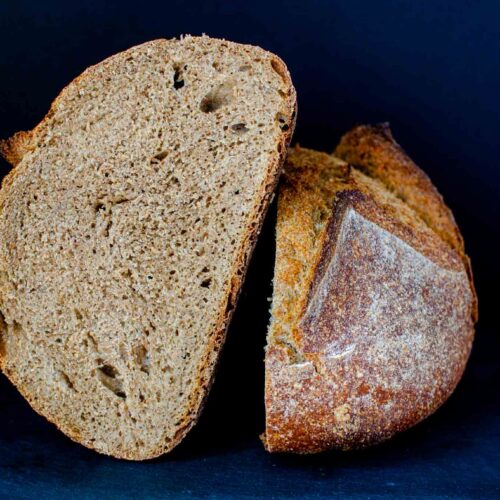
How to Make 100% Whole Wheat Sourdough Bread
Learn how to make 100% whole wheat sourdough bread at home with simple step-by-step instructions. This whole wheat sourdough bread recipe is simple and straightforward, with just 4 simple ingredients, to produce a delicious, wholesome loaf right at home.
Want to Save This Recipe?
Enter your email & I'll send it to your inbox. Plus, get great new recipes from me every week!
By submitting this form, you consent to receive emails from Lockrem Homestead
Ingredients
Whole Wheat Levain
- 36 g sourdough starter
- 36 g warm water
- 36 g whole wheat flour
Autolyse
- 100 g active sourdough starter (the entire levain)
- 350 g warm water
- 500 g whole wheat flour
Salt/Water
- 25 g warm water
- 10 g salt
Instructions
Levain
- Add 36 g of sourdough starter to a clean container like a mason jar. Mix equal parts water and whole wheat flour, 36 grams each, to the jar. Cover the top of the jar with a napkin and rubber band.
Mixing the Dough
- When the levain is ripe and full of bubbles, add the sourdough starter, 350 g of water, and whole wheat flour in a large bowl.
- Let the dough rest for 30 minutes at room temperature so the whole wheat flour can properly hydrate.
- Combine the remaining 25 g of water and salt in a small bowl. Pour over the top of the dough and mix it in completely. I've found the best way to incorporate the water into the dough is by squeezing and folding the dough. Then let the dough rest for 30 minutes.
Stretch and Folds
- Grab the edge of the dough and lift it straight up to stretch it, then fold it over onto itself in the middle of the dough. Turn the bowl a quarter of a turn and repeat, stretching and folding the dough.
- Continue working your way around the sides of the bowl, working the dough until it becomes tight and resistant. This completes one set of stretch and folds.
- Wait 30 minutes and do another set. Continue until you complete 3 sets of stretch and folds with 30 minute increments.
Bulk Fermentation
- Cover the bowl and let the dough rise in a warm place until it increases by 50 percent. This generally takes 5-6 hours but can vary depending on the temperature of the kitchen.
Shape
- Turn the dough out onto a lightly floured work surface.
- Shape the dough using the envelope fold. First, fold the top of the dough down to the middle. Then, fold the bottom of the dough up to meet the other fold in the middle of the dough. Continue to fold each side inward to the middle.
- Flip the dough over with a bench scraper so that the folds are facing down. With two hands cupping the far side of the dough, gently pull the dough towards you, pressing your hands slightly under to create some tension on the top of the loaf. Continue to pull the bread dough, slightly pivoting your starting point until the loaf is a smooth, round shape.
- Light dust a banneton with rice flour and place the dough upside down with the seams facing up. Don't worry if you don't have a banneton, you can use a large bowl and a piece of parchment paper instead. Lift the dough onto a piece of parchment paper with the seam facing down and then using the parchment paper as the handles, lift the dough into the bowl.
Second Ferment
- Cover the bowl or banneton and allow it to sit at room temperature for another hour after shaping before moving to the refrigerator.
Bake
- The following morning preheat a Dutch oven and lid to 450 degrees for 30-45 minutes.
- Remove the bread dough from the fridge and score a long slash on the top of the dough with a razor blade or lame.
- Using the parchment paper, lift the bread dough into the preheated Dutch oven and bake for 35 minutes with the lid. Remove the lid and bake for an additional 20 minutes.Knowing when the bread is done by looks alone is difficult due to its dark color. The bread is done when the bottom of the loaf is tapped and it sounds hollow, indicating that the majority of the moisture is gone. The bread is done baking when an internal temperature reaches 200 degrees.
- Remove the bread from the Dutch oven and place on a wire rack to cool completely before slicing.
Storage
- Place bread in an airtight container and store at room temperature for up to 5 days.
Notes
Nutrition information is automatically calculated, so should only be used as an approximation.
Nutrition
Calories: 1855.2kcalCarbohydrates: 392.6gProtein: 71.8gFat: 13.5gSaturated Fat: 2.3gPolyunsaturated Fat: 6.3gMonounsaturated Fat: 1.5gSodium: 3887mgPotassium: 1946.5mgFiber: 57.6gSugar: 2.2gVitamin A: 48.2IUCalcium: 184.6mgIron: 19.3mg
Tried this recipe?Let us know how it was!
