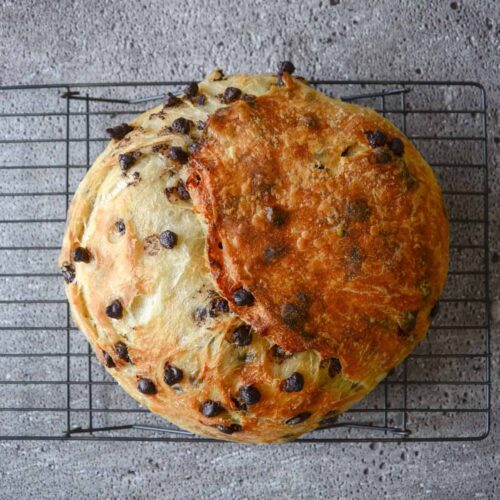
Chocolate Chip Sourdough Croissant Bread
Chocolate chip sourdough croissant bread is loaded with flakey, buttery layers and sweet bits of chocolate, all wrapped in a sourdough loaf of bread. A pain au chocolat in a bite!
Want to Save This Recipe?
Enter your email & I'll send it to your inbox. Plus, get great new recipes from me every week!
By submitting this form, you consent to receive emails from Lockrem Homestead
Equipment
- kitchen scale
- large mixing bowl
- Dutch Oven
- Danish dough whisk
- box grater
- lame or sharp knife
- Digital thermometer
Ingredients
Levain:
- 42 g starter
- 42 g water
- 42 g all-purpose flour
Bread dough
- all of the levain or 125 g (½ cup) active sourdough starter
- 350 g water divided, 1½ cups
- 10 g salt 2 tsp
- 500 g bread flour 4 cups
- 113 g unsalted butter ½ cup
- 235 g chocolate chips 1½ cups
Instructions
Create the Levain
- 1:1:1 Levain: This recipe calls for a levain mixed the night before you mix the dough. Combine 42 g active starter, 42 g water, and 42 g all-purpose flour in a small bowl. Cover and let it sit at room temperature for 8 hours.
- The levain is ready when it has doubled in size, has lots of bubbles, and a slightly sour aroma.
- Grate 113 g (½ cup) unsalted butter into a small dish and refrigerate until ready to add to the dough.
Autolyse
- Add 320 g (1⅓ cups) water and 500 g (4 cups) bread flour to a large bowl and mix with a Danish dough whisk until a shaggy dough forms and all of the flour is incorporated. I found that it helped to use my hands to work the final bits of flour into the dough.
- Cover the bowl and rest for 30 minutes.
Mix the Dough
- Combine 10 g (2 tsp) salt with the remaining 30 g (2 tbsp) water and stir to dissolve the salt.
- Pour the salty water into the bowl over the dough with all of the ripe levain, and mix until fully combined. I find that my hands are the best tool for this job.
- Squeeze and turn the dough until the levain and liquid are adequately distributed throughout the dough. At this point, the dough can look a bit stringy and not fully cohesive; this is ok!
- Cover the bowl and let it rest for 30 minutes.
Stretch and Folds | Strengthen the Gluten
- Over the next 2 hours, the dough will transform from a rough, shaggy croissant dough to a smooth and elastic dough through 5 sets of stretch and folds.
- Grab the edge of the dough and lift it straight up before folding it over onto itself.
- Turn the bowl a quarter turn, and repeat, working your way around the sides of the bowl. Initially, the dough will be loose, but after 10-15 folds, the dough begins to come together.
- Continue to stretch and fold the dough roughly 30 times, or until the dough becomes resistant. This completes one set of stretch and folds.
- Cover the bowl and rest for 30 minutes.
- Continue stretching and folding the dough for a total of 5 sets with 30 minute intervals.
- On the second set of stretch and folds, add half of the grated butter over the top of the dough. Using the same stretch and fold method, incorporate the butter into the dough.
- Cover and rest for 30 minutes.
- Add the remaining grated butter to the dough on the third set of stretch and folds. Cover and rest for 30 minutes.
- Add the chocolate chips at the fourth set of folds, making sure the chips that fall to the bottom of the bowl get mixed in.
- For the fifth and final fold, the dough will be elastic and smooth, with the grated butter and chocolate chips distributed throughout the dough.
Bulk Ferment
- After the stretch and folds are completed, cover the bowl and let it rest at room temperature. The dough is done fermenting when you see plenty of air bubbles beneath the surface, and the edge of the dough where it meets the bowl domes down slightly.
Preshape
- Turn out the dough onto a lightly floured work surface.
- Using a bench scraper and one hand, rotate the dough while pushing the dough under with the bench scraper, into a boule shape.
Bench Rest
- Let the preshaped dough rest on the counter for 30 minutes uncovered. It's normal for the dough to flatten a bit as it rests.
Shape
- Prepare your banneton by dusting it with a bit of rice flour to prevent the dough from sticking.
- Fold the bottom of the dough up to the middle and gently press it into the dough.
- Pull the right side of the dough out a bit to stretch it before folding it over the middle of the dough. Repeat with the left side of the dough.
- Starting from the bottom of the dough ball, roll the dough onto itself until it forms a ball.
Cold Proof
- Use a bench scraper to lift the folded dough into the prepared banneton, with the seam side up. Pinch the seams together.
- Place the banneton into a plastic bag and refrigerate for 8-24 hours. I like to do this step overnight.
Preheat the Oven
- The following morning, preheat the oven to 450F°/232C° with a Dutch oven in the middle of the oven for 30 minutes.
Score and Bake
- Turn out the chilled dough onto a piece of parchment paper. Score the top of the loaf roughly 1 inch deep with a lame or a sharp knife.
- Carefully remove the hot Dutch oven from the oven and lift the bread using the parchment paper as handles, into the Dutch oven. Replace the lid and move to the oven. Lower the oven temperature to 425°F/218°C and bake with the lid on for 30 minutes.
- Remove the lid and bake for 10-15 minutes. The bread is done when the internal temperature reaches 200°F/93°C and the top of the bread is golden brown.
Storage
- Like most baked goods, they're best the day they're baked! Allow the bread to cool completely. Store bread in an airtight container and store at room temperature for up to 3 days.
Notes
Do you have to use a levain in this recipe?
No, but if you have a well-maintained and frequently refreshed starter, you can substitute 125 g of active sourdough starter for the levain in the recipe.Tips
- Be sure to use parchment paper, as a little butter may leak out and cause a little bit of a mess in the Dutch oven.
- The added weight of the butter and chocolate chips will slow fermentation compared to a traditional loaf of sourdough bread, so don't be alarmed when it takes longer than usual!
- Combining the flour and water before adding the salt and sourdough starter gives the flour time to hydrate. In addition, the enzymes are released to make the sugars more available once the starter is added, giving the gluten a chance to begin developing before weighing the dough down with butter.
- It's important that the dough maintains a temperature of 70-72F/C. Similar to making other pastry dough, like rough puff pastry or croissants, it's important that the layers of butter stay cool to prevent too much butter leakage during the bake time. Take the temperature using a digital thermometer to monitor the dough temp. Place the bowl in the fridge for 10 minutes to cool the dough down if it starts to get too warm.
- Because the dough is heavier than a traditional sourdough bread dough with the added butter and chocolate chips, the total bulk fermentation time may be longer than normal. Keep an eye on the dough's temperature to make sure the butter doesn't soften too much. Place the bowl into the refrigerator to cool the dough temperature as needed.
- You can skip the overnight cold proof and bake the bread the same day. Let the dough rise in the proofing basket inside a large plastic bag for a few hours or until the dough is airy and jiggles a bit. After the dough is done proofing, place it into the refrigerator while preheating the oven to let the butter cool a bit before baking. Cold dough prevent butter from leaking out and is easier to score.
Nutrition
Calories: 497.7kcalCarbohydrates: 69.2gProtein: 8.3gFat: 21gSaturated Fat: 12.7gPolyunsaturated Fat: 0.9gMonounsaturated Fat: 3.1gTrans Fat: 0.5gCholesterol: 30.4mgSodium: 489.9mgPotassium: 155.5mgFiber: 1.7gSugar: 17gVitamin A: 354.2IUCalcium: 36.3mgIron: 0.8mg
Tried this recipe?Let us know how it was!
