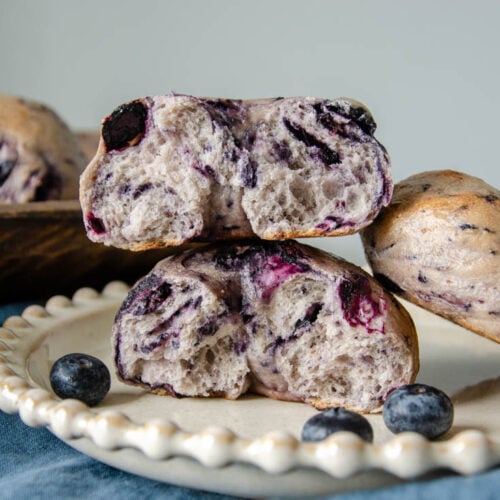
The Best Sourdough Blueberry Bagels
These are the best sourdough blueberry bagels! Fresh and dried blueberries are folded into sourdough bagel dough made with a sweet levain. Chewy homemade bagels made using 100% natural yeast rival any regular bagels you can buy at the store!
Want to Save This Recipe?
Enter your email & I'll send it to your inbox. Plus, get great new recipes from me every week!
By submitting this form, you consent to receive emails from Lockrem Homestead
Equipment
- kitchen scale
- Baking Sheet
- slotted spoon
- bench scraper
- 4 qt saucepan
Ingredients
Sweet Levain Starter
- 20 g sourdough starter
- 60 g water ¼ cup
- 25 g sugar 2 T
- 60 g flour ½ cup
Sourdough Blueberry Bagel
- all sweet levain
- 150 g water ⅔ cup
- 10 g salt 2 tsp
- 50 g honey 2 T
- 562 g bread flour 4½ cups
- 160 g fresh blueberries 1 cup
- 25 g freeze-dried blueberries 1 cup
Instructions
Sweet Levain
- Mix active sourdough starter, flour, water, and sugar in a small jar or bowl. Cover and let rest for 6- 8 hours at room temperature until it reaches its peak.
- I like to do this step right before I go to bed, so it's ready to mix into the dough first thing in the morning.
Mix the Bagel Dough
- The next morning, add the fresh blueberries to the bowl of your stand mixer fitted with the paddle attachment. Mix on low for 1 minute to mash the berries.
- Next, add the sweet levain, honey, salt, and water and mix for 10-15 seconds to break the starter up into the rest of the ingredients.
- Switch to the dough hook attachment and add the bread flour to the bowl. Mix on low speed. (This is speed 2 on a Kitchen Aid mixer.)
- After the first 2 minutes, you'll notice the dough comes together, forming a shaggy dough ball that cleans the sides of the bowl. Continue to mix for 6 more minutes, for a total of 8 minutes.
- Next, add the dried blueberries and mix for an additional 2 minutes.
- At this point, the stiff dough will be tacky, but not sticky. If the dough sticks to your hands when you grab the edge of it or tears easily, it needs more time. Mix for another minute and check the dough again.Because each home is different, the different environments can cause the mixing times to vary. Be sure to look at how the dough behaves more than the exact time to know when it's done mixing. It's done when it's elastic and stretches before breaking. In addition, the dough should be easy to handle without completely sticking to your hands.
- Once it's done, I like to fold the dough a few times with my hands to incorporate all of the dried blueberries into the center of the dough.
- Transfer the bagel dough to a glass bowl and cover with a plate or a damp towel.
Bulk Fermentation
- Let the dough rise in a warm place for 4-6 hours. Though the dough will not have risen much after the bulk ferment, it'll feel strong, cohesive, and more aerated than it did after mixing. The exact time it takes largely depends on the temperature of your home. In the cooler months, the dough takes longer to bulk ferment, and if the temperature is warmer, the fermentation happens faster. I like to place the bowl in the oven with the light on for a consistent environment.
Shape
- Turn out the sourdough blueberry bagel dough onto a lightly floured work surface. Using a bench scraper, divide the dough into 8 equal pieces, roughly 135g each. Shape each piece of dough into smooth balls and then let them rest for 5 minutes to allow the gluten to relax.
- With your thumb and index finger, press a hole into the center of the dough ball. Gently stretch the hole larger until it has a bagel shape, roughly 3-3 1/2 inches. Make sure to stretch the dough out as evenly as possible all around the bagel.
- Once you shape all 8 pieces of dough into the bagel shape, go through them a second time to stretch the holes a bit larger before placing the shaped bagels onto a parchment-lined baking sheet. This gives the gluten a chance to relax so they don't shrink back when stretched.
Proof
- Cover the bagels with a piece of plastic wrap or a tea towel and allow to proof for 4 hours. I like to proof the bagels in the oven with the light on, reducing the proofing time to 2 hours. Since it's a closed environment, I don't cover the bagels with anything, and they still stay fresh.
- The bagels are done proofing with they look puffy and feel soft when you touch them. At this point, you can cold proof them overnight or bake them right away. To cold-proof, cover them loosely with plastic wrap and place them into the fridge overnight.
Boil
- The next day, preheat the oven to 425°F/220°C. Bring a large pot of water to a boil over medium-high heat.
- Remove the bagels from the fridge. Gently add one or two bagels to the water and boil the bagels for 30-45 seconds. Flip the bagel and boil for another 30-45 seconds on the second side.
- Properly proofed bagels will float. If the bagel sinks, it indicates there's not enough air in the dough, and it needs more time to proof.
- PRO TIP: Proof the bagels on parchment paper because it makes it easy to move them from the baking sheet into the boiling water. Use a small scissors and cut the parchment paper around each bagel. Gently lower the bagel, using the parchment paper, into the boiling water. Once the bagel gets wet, it slides off the paper easily. Place the paper back onto the baking sheet to use for baking.
- Place boiled bagels onto the parchment-lined baking sheet and continue with the remaining bagels.
Bake
- Place the bagels into the oven and bake for 20-25 minutes.
- The bagels are done when they are lightly golden brown and have an internal temperature of 200°F/94°C.
- Transfer the bagels onto a cooling rack. For the best texture, wait until the bagels cool to room temperature before slicing open. (However, we often dive right in and enjoy one fresh from the oven!)
Store
- Allow the bagels to cool completely before placing them into an airtight container. Store at room temperature for up to 3 days.
Notes
Nutrition information is automatically calculated, so should only be used as an approximation.
Can I Use Frozen Blueberries?
This sourdough bagel recipe was formulated to work best with regular blueberries. However, you can use frozen blueberries too. Allow the berries to thaw and drain the excess juice before adding to the dough; otherwise, the dough will be too wet. Then, continue to mix the sourdough blueberry bagels with frozen blueberries in the same way as the recipe states. The frozen blueberries may release more color into the dough and turn it a bluish-grey hue. This is normal and can vary depending on the berries.Are Sourdough Bagels Healthier?
Yes, they are! The use of an active sourdough starter in sourdough bagels allows for a slow, long ferment compared to traditional bagels that rely on instant yeast for the leavening agent. This extra time helps break down the phytic acid found in the grain, improving the digestibility of the bagels.Do I Need a Stand Mixer to Mix the Bagels? Can I Mix Them by Hand?
A stand mixer makes mixing the stiff sourdough bagel dough quick. However, not everyone has a stand mixer. If you don’t have a stand mixer, this dough can be kneaded by hand for about 12-15 minutes until it's smooth. Alternatively, after mixing, you can complete 4 sets of stretch and fold the dough every 15 minutes. The dough is stiff and may require using two hands to stretch and fold. By the last set of stretch and folds, the dough will be more elastic and smooth. After the last set of stretch and folds, wait 15 minutes before adding the dried blueberries. Continue with the directions as stated.Why Do You Have to Boil Sourdough Bagels Before You Bake Them?
This sourdough bagels recipe requires the bagel dough to boil for a short amount of time before baking. This creates the chewy texture that bagels are known for, so don't skip this step!Nutrition
Calories: 336.5kcalCarbohydrates: 70.7gProtein: 9.5gFat: 1.4gSaturated Fat: 0.2gPolyunsaturated Fat: 0.6gMonounsaturated Fat: 0.1gSodium: 488.6mgPotassium: 120.5mgFiber: 2.8gSugar: 12.1gVitamin A: 12.2IUVitamin C: 2mgCalcium: 15.9mgIron: 1.1mg
Tried this recipe?Let us know how it was!
