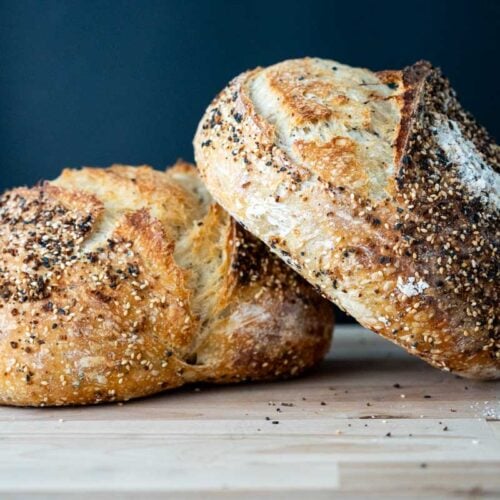
Sourdough Everything Bread Recipe
Sourdough Everything Bread is full of flavor and has a great, chewy texture! Everything bagel seasoning is folded into the dough before baking with a seasoned topping.
Want to Save This Recipe?
Enter your email & I'll send it to your inbox. Plus, get great new recipes from me every week!
By submitting this form, you consent to receive emails from Lockrem Homestead
Equipment
- 6 qt Dutch oven
- mixing bowl
- kitchen scale
- Danish dough whisk
- parchment paper or dough sling
Ingredients
Levain
- 42 g active sourdough starter
- 42 g water
- 42 g all-purpose flour
Sourdough Everything Bagel Bread Ingredients
- 365 g water 1½ cups + 1 tbsp
- 125 g all of levain (can replace with active sourdough starter) ½ cup
- 6 g sea salt 1 tsp
- 45 g everything bagel seasoning 4 tbsp, divided
- 500 g bread flour 4 cups
Instructions
Mix the Levain
- Combine 42 g active starter, 42 g water, and 42 g all-purpose flour in a clean container, like a pint mason jar. Cover and sit in a warm place for 3 hours, or until it comes to its peak.
Mix Sourdough Bagel Bread Dough
- Combine 365 g (1 ½ cups + 1 tbsp) water, 1 tsp salt, 125 g (½ cup) levain, and 25 g (2 ½ tbsp) everything bagel seasoning into a large mixing bowl. Use a dough whisk to mix the ingredients, breaking up the starter.
- Next, add 500 g (4 cups) bread flour and mix until all of the flour is incorporated with the other ingredients.
Strengthen the Dough | Bulk Fermentation
- Cover the bowl with a piece of plastic wrap or a damp tea towel and let rest for 30 minutes.
- Strengthen the sourdough bagel dough with a series of stretch and folds. Grab the side of the dough, lift it straight up, and fold it over to the middle of the bowl. Rotate the bowl a quarter of a turn and repeat. Continue the stretch and folds until you feel the dough become resistant, roughly 8-12 folds. Cover and let the dough rest for 30 minutes.
- This completes one set of stretch and folds. Continue for a total of 4 sets of stretch and folds. The bread dough will look shaggy and break easily at first but will transform to a smooth, elastic dough by the end of the stretch and fold process.
- Cover the bowl and set in a warm spot in your kitchen for 2-4 hours or until the dough doubles in size. The bulk fermentation process can vary depending on the room temperature. My kitchen is cool during the winter months so I often place the covered bowl into the oven with the light on.,
Shape
- Use a dough scraper and turn the dough out onto a lightly floured work surface. Gently adjust the dough into a circle.
- To shape the dough, starting at the top, stretch the dough outward and fold it down to its center. Repeat on the bottom. Then, fold each side to the middle. Use a bench scraper and gently flip the dough over so that the folds are facing down.
- Let the dough rest for 5-10 minutes to allow the gluten to relax. With lightly floured hands, cup the dough and pull it towards you to shape it into a tight ball, adjusting your hand placement as needed.
Proof
- Place the dough into a banneton dusted with rice flour seam side up, cover, and proof for two hours at room temperature.
Optional Cold Proof
- Instead of proofing at room temperature, place the covered bowl or banneton in a plastic bag and refrigerate for up to 24 hours.
Bake
- Preheat the Dutch oven for 30 minutes at 450°F/232°C.
- Tip the sourdough out of the banneton and onto a piece of parchment paper or a dough sling.
- Spray the top of the dough with water. Sprinkle the top of the dough with 20 g (2 tbsp) everything bagel seasoning, gently pressing it into the dough.
- Use a lame, sharp knife, or clean razor blade to score the top of the dough roughly 1/4-1/2 inch deep, giving the bread a place to expand as it bakes.
- Bake for 30 minutes with the lid on. Remove the lid and bake for an additional 10-15 minutes. The internal temperature of the bread will be 200°F/94°C when it's done.
- Remove the bread from the Dutch oven and place on a wire rack to cool to room temperature before cutting. While it may be tempting to slice a piece of bread while it's warm (because it's delicious) doing so will cause moisture to escape, which can cause the bread to be drier.
Storage
- Place bread in an airtight container and store at room temperature for 3 days.
Notes
Nutrition information is automatically calculated, so it should only be used as an approximation.
If you don't own a banneton basket, place the dough onto a piece of parchment paper with the seam down, the smooth side up, and lift it into a bowl.
Nutrition
Calories: 122.4kcalCarbohydrates: 24.7gProtein: 4gFat: 0.5gSaturated Fat: 0.1gPolyunsaturated Fat: 0.2gMonounsaturated Fat: 0.05gSodium: 375.8mgPotassium: 34.1mgFiber: 0.8gSugar: 0.1gVitamin A: 0.6IUCalcium: 5.9mgIron: 0.4mg
Tried this recipe?Let us know how it was!
