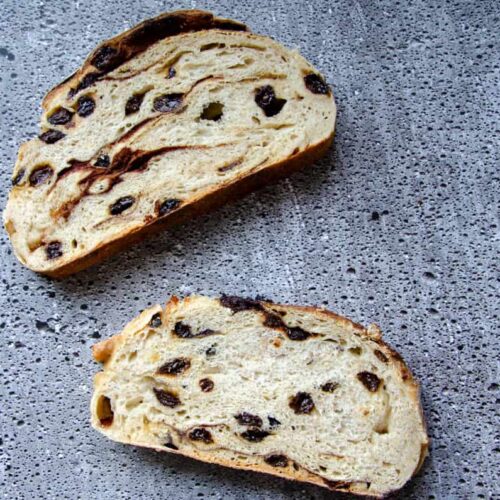
Cinnamon Raisin Sourdough Bread Recipe
This cinnamon raisin sourdough bread recipe makes a sourdough artisan bread full of a sweet cinnamon swirl that's dotted with plump raisins for a tried and true favorite. Your whole family is sure to love this bread after just one bite.
Want to Save This Recipe?
Enter your email & I'll send it to your inbox. Plus, get great new recipes from me every week!
By submitting this form, you consent to receive emails from Lockrem Homestead
Equipment
- 1 6 qt Dutch oven
- 1 large mixing bowl
- 1 Danish dough whisk
- 1 lame
- 1 banneton
- 1 kitchen scale
Ingredients
Cinnamon Raisin Bread Dough
- 125 g sourdough starter
- 1 tbsp salt
- 350 g water
- 500 g bread flour
- 50 g rye flour
Add-Ins
- 113 g raisins ¾ cup
- 50 g brown sugar ¼ cup
- 1 tbsp cinnamon
Instructions
Mix The Dough
- Add 125 g (1/2 cup) of active starter and 350 g of water to a large mixing bowl, then stir to break up the starter into the water. Next, add 1 tbsp of salt, 50 g of rye flour, and 500 g of bread flour to the bowl. Using a Danish dough whisk, mix the flours with the water and starter until a cohesive, shaggy dough forms. Cover the bowl with a plate or plastic wrap and let it rest for 20-25 minutes.
- While the dough rests, prepare the raisins. Place 75 g of raisins in a heat-proof bowl and cover them with boiling water. Let them soak while you develop the gluten in the bread dough through a series of stretch and folds.
Stretch and Folds
- Perform a series of stretch and folds to strengthen the gluten.
- Grab the dough along the sides of the bowl and lift it straight up, allowing it to stretch, before folding it over onto itself in the center of the bowl. Turn the bowl a quarter turn and repeat the stretch and fold. Continue this process until the dough becomes stiff and resistant, roughly 8-10 folds. This completes one set of stretch and folds. Cover the bowl and let the dough rest for 30 minutes.
- Before the second set of stretch and folds, drain the raisins and incorporate them into the bread dough. Proceed with the second set of stretch and folds, ensuring that the raisins are mixed in well. Cover the bowl and let it rest for another 30 minutes. Finally, perform a third set of stretch and folds, ensuring the raisins are fully mixed into the dough by the end of this final round. However, by the end of the stretch and folds, if there are any loose raisins, I like to lift the dough and tuck the raisins and the ends of the dough under as I lift.
Bulk Fermentation
- After the last set of folds, cover the bowl and let the dough rise in a warm area of the kitchen. The dough has finished bulk fermentation when it has doubled in size and the top has a domed shape.
Shape
- In a small bowl, mix 1 tbsp of cinnamon with 50 g of brown sugar.
- Turn the dough out onto a lightly floured work surface and stretch it into a 10 x 12 inch rectangle. Sprinkle three-quarters of the cinnamon sugar mixture over the top, leaving a one-inch border around the edges. Fold the bottom portion up to the middle of the rectangle and press the edges together. Then, fold the top down to meet the bottom portion and press the edges together again. Sprinkle the remaining cinnamon mixture over the dough and roll it into a ball.
- Pinch the sides of the dough together. Cup the far end with both hands and gently pull it toward yourself. Adjust your hands and continue pulling until the dough forms a smooth, round ball. Be careful not to pull too much, as this may cause the top to rip open.
- Tip: Pinching the edges together keeps the sugar within the dough so it doesn't leak out during the cold ferment.
Second Rise | Cold Ferment
- Place the cinnamon raisin bread dough into a banneton dusted with rice flour, seam side up, and pinch any seams together. Put the banneton into a plastic bag and refrigerate for 8 hours or overnight. This overnight rise allows the flavors of the bread to develop.
Bake
- The next day, preheat the Dutch oven to 450°F (230°C). Turn the dough out onto a piece of parchment paper and score the top with a lame. A simple score is best. If a raisin pops out when you score the bread, toss it or it will burn. Lift the dough using the parchment paper as handles and place it into the hot Dutch oven, replace the lid, and bake for 30 minutes. Remove the lid and bake for an additional 10-15 minutes.
- Remove the bread from the Dutch oven and let it cool on a wire rack before slicing.
Notes
Adding sugar to bread dough can cause a syrupy mess since sugar is hygroscopic, drawing out moisture as it sits. Pinching the edges together keeps the sugar within the dough so it doesn't leak out during the cold ferment.
Can you freeze cinnamon raisin bread?
Yes, to freeze the whole loaf, allow the bread to cool completely and wrap it tightly in a few layers of plastic wrap. Label with the name and date and place into the freezer. For best quality, use within 3 months. Thaw the loaf at room temperature or in the fridge before enjoying. To freeze cinnamon raisin bread slices, lay cut pieces of bread on a baking sheet and flash freeze. After the bread slices are frozen, remove them from the baking sheet and place them into a freezer-safe bag, removing as much air as possible before returning to the freezer. This makes it easy to pull out one piece at a time to enjoy.How long does cinnamon raisin bread last?
Store sourdough cinnamon raisin bread at room temperature for up to 3 days for the best flavor. But don't throw it out if it starts to get a bit dry. Instead, cube the bread and make a pan of cinnamon raisin bread pudding.Can I leave the raisins out of cinnamon raisin bread?
Yes, if you don't want raisins in your cinnamon raisin sourdough, you can leave them out. Otherwise, you can also replace them with another dried fruit. Just be sure to soak and dry whatever type of dried fruit so it doesn't pull moisture from the dough.Can I add the cinnamon into the dough instead of creating a swirl?
Because cinnamon has antimicrobial properties, it can slow down fermentation. This is why we add it to the dough as it's being shaped rather than mixing it into the bread dough. Nutrition information is automatically calculated, so it should only be used as an approximation.Nutrition
Calories: 164.8kcalCarbohydrates: 35.5gProtein: 4.5gFat: 0.6gSaturated Fat: 0.1gPolyunsaturated Fat: 0.3gMonounsaturated Fat: 0.1gSodium: 440.8mgPotassium: 107.6mgFiber: 1.9gSugar: 3.2gVitamin A: 2.1IUVitamin C: 0.4mgCalcium: 15.9mgIron: 0.6mg
Tried this recipe?Let us know how it was!
